Carollo Engineers

 
BIOBROx™ Treatment System and Services
DEVELOPMENT OF AN INNOVATIVE OXIDANT-LADEN RESIDUALS TREATMENT SYSTEM


BIOBROx™ treats oxidant-laden residuals by blending the residual stream with scalped municipal wastewater followed by treatment in a fixed-bed reactor.

BIOBROx™ consulting services of Carollo Engineers provides consulting and engineering services for the removal of oxidant-laden residual streams from water and wastewater using a blending and biodegradation treatment scheme. To identify the appropiate design and operating conditions, engineers and scientists evaluate the water quality of a given oxidant-laden waste stream. A BIOBROx™ system that incorporates the BIOBROx™ process under the appropriate design and operating conditions to convert oxidants to innocuous end-products, eliminating costly disposal or further handling of the waste streams.


Oxidants such as nitrate, perchlorate, bromate, or selenate can be removed from drinking water using ion exchange (IX), reverse osmosis (RO), electrodialysis reversal (EDR), or direct biological treatment . One concern with using IX, RO, or EDR to treat oxidants is that they each produce a concentrated, oxidant-laden residual stream that typically requires further treatment. One method for treating oxidant residuals involves biological processes, which convert oxidants to innocuous by-products. Biological processes have certain disadvantages: degradation kinetics of these systems are generally slow (typical required contact times are ≥ 24 hours); associated microbial communities are sensitive to changes in salinity; and high concentrations of a substrate (e.g., bacterial food), such as ethanol, must be added to the system. In other words, biological systems designed to treat oxidant residuals require large reactor volumes, lack robustness, and exert high consumable costs.

BIOBROx™ - An Innovative Residuals Treatment Approach

Carollo Engineers has developed a novel approach to treating oxidant-laden residuals that involves blending the residual stream with scalped municipal wastewater, followed by treatment in a fixed-bed bioreactor. BIOBROx™ (Biodestruction of Blended Residual Oxidants - U.S. Patent No. 7,318,895) eliminates the target oxidant from the residuals stream prior to sewer discharge or reuse application.
In effect, blending the residuals stream with municipal wastewater decreases the dissolved oxygen (DO) concentration and salinity of the untreated stream (i.e., increases oxidant degradation kinetics) and eliminates the need to add a substrate or bacterial seed to the bioreactor system. Resulting reactor volumes and consumable costs are minimized and process stability improves. The advantages of this approach are further summarized in the table below.

Process Development from Conceptualization to Full-Scale Implementation

Carollo developed BIOBROx™  in conjunction with a project focused on solving real-world challenges for the Magna Water District, Utah (Magna). The Magna Water District serves potable water to approximately 28,000 customers near Salt Lake City, Utah. This water supply includes groundwater impacted by perchlorate, arsenic, and TDS.


In 1999-2000, Carollo conducted a six-month pilot study showing that, due to the presence of high silica and sulfate levels in the groundwater, EDR would be the most feasible treatment alternative for Magna. EDR is a separation-based process in which an electrical potential drives charged species (i.e., perchlorate, arsenic, TDS) across ion exchange membranes, thereby removing them from the raw water.


EDR generates a contaminant concentrated residual stream that, under current USEPA regulations, could be discharged to the sewer system. However, Magna, in partnership with the local industry responsible for the original perchlorate contamination, opted to seek a method that would remove perchlorate from the brine stream prior to sewer discharge, thereby eliminating future environmental contamination.


Bench-Scale Testing. As part of AwwaRF Project 2859, Innovative Alternatives to Minimize Arsenic, Nitrate, and Perchlorate Residuals, a three-month bench-scale study was performed to investigate the feasibility of the treatment concept. Perchlorate-spiked wastewater from the Magna Water District was used to biologically acclimate activated carbon in a 2-inch-diameter fixed-bed reactor. Seeded only with microorganisms indigenous to the raw wastewater, the fixed-bed bioreactor demonstrated efficient perchlorate removal while utilizing only background organics as substrate. Perchlorate removal to below detection was achieved and sustained at empty-bed contact times (EBCTs) as low as 30 minutes. While these data were promising, additional research was needed to evaluate process performance when a perchlorate-laden residual stream was blended with the wastewater prior to treatment in the fixed-bed bioreactor.


Pilot-Scale Testing. The USEPA funded a seven-month pilot study at Magna's Barton Well Field in 2004-05 to demonstrate the efficacy of the BIOBROx™ process for removing perchlorate from an EDR concentrate stream. An EDR pilot plant was operated to remove perchlorate, arsenic, and TDS from groundwater, and the resulting concentrate stream was blended with scalped municipal wastewater and treated in a pilot-scale fixed-bed bioreactor. The data showed that using an EBCT of 10 minutes and a 1.5:1 wastewater flow to EDR concentrate flow blend ratio, the fixed-bed bioreactor achieved sustained perchlorate removal to below detection while demonstrating 98 percent, 65 percent, and 84 percent removal of influent nitrate, biochemical oxygen demand, and total suspended solids, respectively.


Carollo and the Magna Water District completed two applied research studies to evaluate the efficacy of the BIOBROx™  system for removing perchlorate from membrane concentrate.
The associated required reactor volume would be a small fraction of the volume required by “conventional” biological residuals treatment systems, and no consumables would be required. Testing also showed that the system was robust with respect to process upsets and seasonal temperature variation.


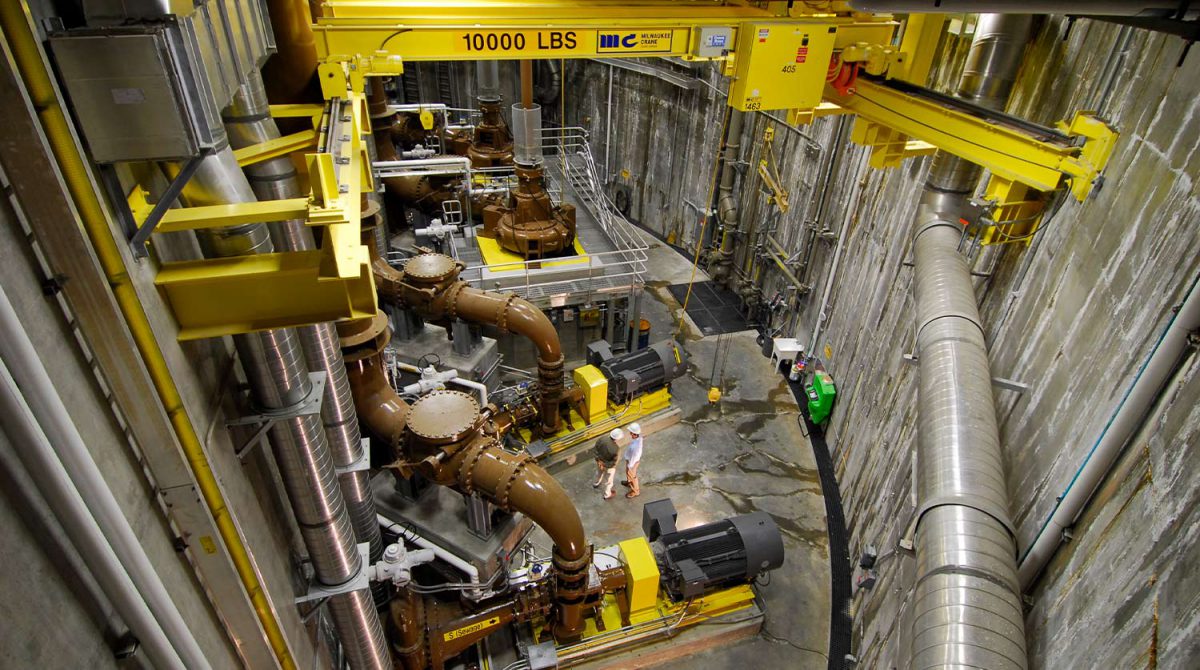
Full-Scale Facility. Based on the success of the pilot-scale study, Magna and Carollo Engineers designed and built a 3.75-mgd BIOBROx™ facility. The facility was started in 2009 and performance data are now being collected.

Conclusions

The need for long residence times, specialized microbial inocula, and high concentrations of exogenous substrate limit the applicability of existing processes used to biologically stabilize concentrated oxidant residuals. This bench- and pilot-scale work has shown that BIOBROx™ provides an efficient alternative for post-treatment of separation-based oxidant removal processes, such as EDR, IX, or RO.


For more information on consulting services or purchasing the BIOBROx™ system, please contact Carollo's Marketing Department at 4600 E. Washington Street, Suite 500, Phoenix, AZ 85034, 602-263-9500, carollo.com.


 Advantages of the BIOBROx™ Approach for Treating Oxidant-Laden Residual Streams      

 Critical Parameters Impact on Treatment "Conventional" Biological Residuals Treatment Processes BIOBROx™
 

Dissolved oxygen concentration


Inhibits degradation of alternative oxidants, such as perchlorate, nitrate, bromate, and selenate.


Treats a fully aerobic oxidant residual stream.


Blends oxidant residual stream with municipal wastewater stream to decrease the bulk DO concentration, thereby lowering required treatment contact time.


Salinity


Generally reduces kinetics of microbiological activity.


Treats oxidant residual streams at 3-6 percent salinity.


Blends oxidant residual stream with municipal wastewater to decrease bulk salinity, thereby lowering required treatment contact time.


Bacterial substrate (i.e., food)


If limiting, oxidant biodegradation will be incomplete.


Requires high doses of an exogenous substrate such as ethanol.


Organics in the municipal wastewater serve as the bacterial substrate; no exogenous electron donor is required.


Microbial seed


Oxidant degradation will be slow or nonexistent if bacterial community cannot thrive under feed water quality conditions.


Requires seeding with exogenous, salt-tolerant bacteria, which tend to be highly sensitive to changes in water quality.


Lower salinity in the blended water allows bacteria in the municipal wastewater to serve as the required microbial seed; resulting biofilms are robust.

Have questions about water treatment? Contact us today.
Sign In